

What the business is
A contractor storage yard is a piece of industrial land split into fenced yards. Each tenant gets a gated space to park trucks, trailers, and equipment, and pays by the month.
The opening is a gap in the market. Commercial listings usually offer one to three acres on a three- to five-year lease. Small, medium, and large yards on month-to-month terms sit in the middle, and few landlords offer them.
The customers are service businesses with vehicles: roofers, landscapers, electricians, plumbers, and HVAC companies.
Numbers to expect
Every guide uses these same eight lines. Each number is marked as an owner’s own figure or as our estimate.
| Startup costOn leased land, for the full project. | $300,000 to $500,000From Chris of Longyards |
|---|---|
| Cash out of pocketThe rest is financed. | $30,000 to $50,000From Chris of Longyards |
| Price per customerPer contractor yard. Larger yards rent for up to $4,000. | $300 to $1,600 a monthFrom Chris of Longyards |
| Time to first customersWe have not asked an owner this on camera. | No figure yetNot yet known |
| Monthly revenueOur math: Chris’s rent range times 20 yards. He did not share revenue. | $6,000 to $32,000Sweat Venture estimate |
| Running costsManagement from $1,000 and on-site checks from $500, before tax and insurance. | $1,500 a month and upFrom Chris of Longyards |
| Profit marginWe have not asked an owner this on camera. | No figure yetNot yet known |
| Owner hoursPer yard, once it is built and rented. | As little as 5 a monthFrom Chris of Longyards |
Owner figures are as stated on camera. We have not verified them, and your market will differ.
How we got the revenue figure
Chris shared his rents: $300 to $1,600 a month for a typical contractor yard. We assumed a site with 20 yards, all rented. That gives $6,000 a month at the low rent and $32,000 a month at the high rent. The 20-yard count is our assumption, not his.
From our interviews
We spent a day with Chris, the founder of Longyards, at his Florida site. He lost his construction company, then rebuilt by renting yards to contractors.
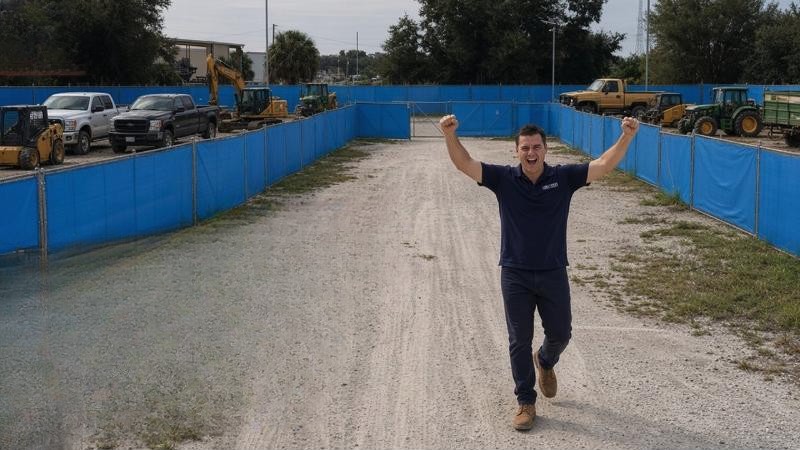
Our interview with Chris of Longyards, 45 minutes.
"You fish with a net at the beginning. Then you go to a spear when you know exactly the type of fish you’re looking for."
Chris on what the business is (1:54)
Chris on signing his first five tenants (14:32)
Chris on running a yard (43:21)
Read the full case studyChris’s story, his numbers, and what he would do differently.Chris of LongyardsHow to start one
- Find the land. Compare the land price to what yards rent for nearby. Leasing needs far less cash than buying. Check for easements first: one added about $800,000 and a year at Chris’s Florida site.
- Pay for it. Banks may say no on a first yard. Chris used seller financing of about $70,000 and brought in an investor once five yards were rented.
- Build the yard. Fencing, a gate, conduit, and power, plus permits in some places. Lay out the roads first, and keep the fencing movable.
- Sign your first tenants. Call contractors, post online, and hand out cards. Expect to explain the product, because most contractors have not seen a yard like this.
- Run it. Set rules in the lease, use cameras and in-person checks, and keep any one tenant under half the property.
Contractor storage yards: 60 out of 100
This scores the type of business, not any owner we interviewed. It is based on one interview so far, and your numbers will vary. A higher score is better for a first-time owner.
- Startup money2/5
You need $30,000 to $50,000 in cash and the ability to borrow $300,000 or more.
Counts for 24 of the 100 points. - Speed to first income2/5
Land, permits, and the buildout all come before the first rent check. One easement cost Chris a year.
Counts for 24 of the 100 points. - Earning potentialSweat Venture estimate3/5
By our math, 20 yards at Chris’s rents bring in $6,000 to $32,000 a month, before the land and loan payments.
Counts for 20 of the 100 points. - Repeat income5/5
Tenants pay rent every month. Leases are month to month, so a tenant can also leave quickly.
Counts for 16 of the 100 points. - Owner time5/5
Once a yard is built and rented, it can take as little as five hours a month.
Counts for 8 of the 100 points. - Ease of entry3/5
You manage a construction job and explain a product most contractors have not seen. Construction experience helps.
Counts for 8 of the 100 points.
Every guide rates its type of business 1 to 5 on the same six points. Startup money and speed to first income count the most.
Before you sign for land
- Talk to local contractors first. Line up tenants before the land where you can.
- Compare the land cost to what yards rent for in that area.
- Check for easements and what they could trigger.
- Plan the roads first, then the yards.
- Write your rules into the lease: no oil work, and no living on site.
- Budget for upkeep, such as snow removal or landscaping.
- Keep any one tenant under half the property.
Comments
No comments yet. Log in to be the first.