
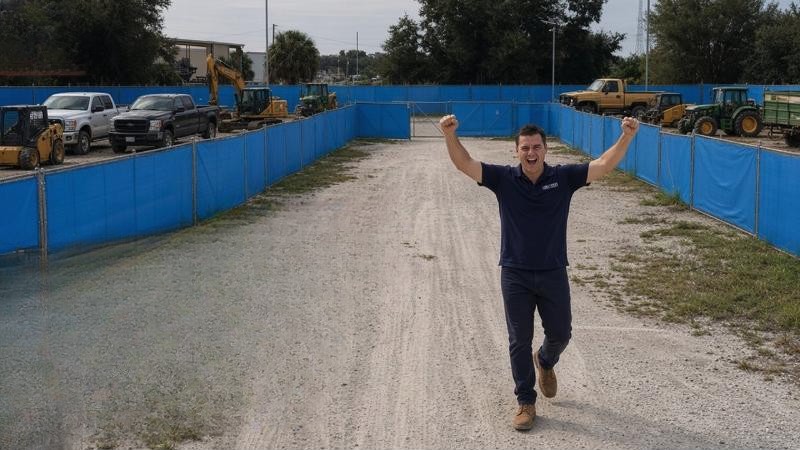
The full interview, 45 minutes. Each section below links to the part where Chris explains it.
Chris’s numbers
These are Chris’s own figures for Longyards, as he stated them in the interview. They are not Sweat Venture estimates.
| Rent per yard | $300 to $4,000 a month |
|---|---|
| Typical contractor yard | $300 to $1,600 a month |
| Lease term | Month to month |
| Startup on leased land (recent franchise) | $500,000 project, $50,000 out of pocket |
| Smallest version he mentions | $300,000 project, $30,000 out of pocket |
| Buying instead (his Florida site) | About $1M land, $1.5M to $2.5M buildout |
| Management cost | $1,000 to a few thousand a month |
| On-site checks | $500 to a few thousand a month |
| Owner time once it is running | As little as 5 hours a month |
We have not verified these figures, and your market will differ.
What the business is
"I rent dirt to contractors," is how Chris puts it. A contractor storage yard is a piece of industrial land split into fenced yards. Each tenant gets a gated space to park trucks, trailers, and equipment, and pays by the month.
The opening is a gap in the market. A contractor who needs a yard today finds almost nothing on the classifieds sites. Commercial listings offer one to three acres on a three- to five-year lease. Small, medium, and large yards on month-to-month terms sit in the middle, and almost nobody offers them.
At his Florida site, every yard has its own power outlet. Some water service is available, and he also rents offices and enclosed storage boxes alongside the yards.
Who rents a yard
His first tenants were a roofer, a landscaper, an electrician with a fleet, and an entrepreneur who stored a bit of everything. That mix is the point: nearly any service business with vehicles is a prospect.
As Longyards has grown, larger customers have started calling. Chris says infrastructure developers and military contractors now ask him to solve the same problem at a bigger scale.
He also likes who he is tied to. Plumbers, electricians, HVAC companies, and renovators are, in his words, the businesses AI is "coming for last."
Find the land
Chris's first property was eight minutes from his house in Ottawa, Ontario. He did not start with a national search. He started with land he could reach and work on himself.
- Compare land price to local yard rents. Expensive cities need higher rents to work. Cheaper land with lower rents can produce a better return.
- Lease or buy. Leasing the land needs far less cash. Buying costs more and takes longer, but you own the asset underneath the business.
- Test small before you bet big. Chris now looks for ways to prove demand in a market before committing money to real estate.
- Check for easements. At his Florida site, an easement forced him to widen a neighbor's road, add a separate entrance, and build water detention. He says it added about $800,000 and a year.
Pay for it
No bank would lend on the first yard, and no investor would back it. Chris had just lost everything and was back on the tools himself. Here is how he got the property anyway.
- Seller financing. He describes a seller take-back of about $70,000, with two years to make the property work or hand it back.
- A payment plan for his partner. He bought out his brother over time instead of in one payment.
- Sweat instead of cash. He cleared the trees with a chainsaw and put every dollar from his construction jobs into the site.
- Proof before investors. Once five yards were rented, an investor backed him and he paid off the owner.
Today, he says Longyards franchises are listed in the SBA franchise directory, which makes bank loans easier to get. Either way, you need to be someone a bank will lend to, not only someone with the down payment.
Build the yard
The buildout is light compared with a building: fencing, a gate, conduit, and power, plus permits in some places. Chris compares it to finishing a basement. You still have to hire the trades and manage the job.
For the layout, the roads come first. The yards are cut in after, sized to the demand in the area.
- Keep the fencing movable. A tenant who needs three yards gets three, with the fence between them removed.
- Do not let one tenant dominate. Chris tries to keep any single tenant under half the property, so one move-out cannot sink the site.
- Use a big tenant to start, then fill in. An anchor gets the site going. Small, medium, and large yards fill the rest.
Sign your first five tenants
There was no clever marketing behind the first five. Chris made phone calls, posted everywhere online, and handed business cards to drivers at red lights and gas stations. If he saw a tow truck, he asked the driver if he needed a yard.
"You fish with a net at the beginning. Then you go to a spear when you know exactly the type of fish you're looking for."
Expect to explain the product. Contractors know they have a parking problem, but most do not know a yard like this exists. Chris calls it an education process as much as a sales process, and says it is the part independent operators most often get wrong.
Now that demand comes to him, he reverses the order: he finds the tenants first, then the land. He says a site can be two-thirds leased before construction starts.
Run it
The first build is the heavy lift. After that, Chris says a single yard can take as little as five hours a month. Contractors are easy tenants. If the gate is crooked or there is a pothole, they tend to fix it themselves.
Set the rules early and enforce them fast. He will not rent to mechanics doing oil work, because of contamination, and he watches for people living in RVs on site. Tenants do not always do what they said they would, so he relies on cameras and regular in-person checks. One tenant once charged the public to fire a flamethrower in his yard. "No flamethrowers" was not in the lease.
Know your fixed costs. Property tax, insurance, a little power, and internet. Then add site upkeep: snow removal runs five figures a year on his ten acres in Canada, and Florida needs landscaping instead.
Cover four jobs. Sales, on-site checks, customer service, and back-office admin. On one site, the owner can do all four.
Automate one task at a time. Chris uses AI across outreach, underwriting, and his CRM. His rule is to do a task by hand first, then automate it in chunks, so a mistake is easy to find.
Chris’s decisions
What he would do differently
- Find the tenants before the land. On his first yard he bought the land, then hunted for tenants. Now he says a site can be two-thirds leased before construction starts.
- Check for easements before buying. At his Florida site, an easement added about $800,000 and a year.
- Prove demand before committing to real estate. He now tests a market first.
On your own, or as a franchise
Chris sells Longyards franchises, so weigh his view with that in mind. His case for the franchise: help finding land and tenants, step-by-step training, and a franchise fee with no royalty until the site makes money.
People have also done it alone. He says some have succeeded, and others are losing money every month. The question he would ask: are you confident you can fill the yards yourself? If yes, go. If not, get help.
The people he thinks fit best have grit, some cash, the ability to borrow, and ideally some construction experience to oversee the buildout.
Before you sign for land
- Talk to local contractors first. Line up tenants before the land where you can.
- Compare the land cost to what yards rent for in that area.
- Check for easements and what they could trigger.
- Plan the roads first, then the yards.
- Write your rules into the lease: no oil work, and no living on site.
- Budget for upkeep, such as snow removal or landscaping.
- Keep any one tenant under half the property.
Get every new guide by email
One email each time we publish a guide.
Comments
No comments yet. Log in to be the first.