
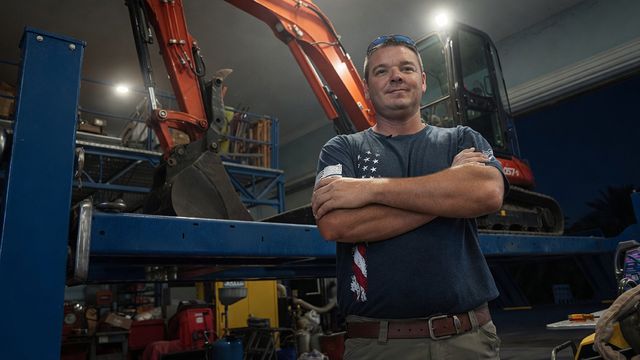
 Watch on YouTube
The full interview, about 55 minutes.
See all interviews on the Sweat Venture channel
On this page
Titan Construction at a glance
Robert’s numbers
These are Robert’s own figures, as he stated them in the interview. They are not Sweat Venture estimates.
| Started his business | Around 2010 to 2011 |
|---|---|
| First machines | 2, at 0% financing |
| Machines today | About 25 |
| Property today | 15 acres |
| Trees on the land when he bought it | About 5,000 |
| Palm price, before and after | $25 a foot to $200 a foot |
| Typical job margin | 28% to 30% |
| Best job margin | 55% |
We have not verified these figures, and your market will differ.
Their path
- Age 13Learns to weld
His father enrolls him in an adult trade school program.
- Before 2008Residential construction
Then bridges and post-tension concrete after the crash.
- Around 2010Starts Titan
An acre of rented land and shipping containers.
- Today15 acres
About 25 machines and a palm tree business.
How they started
Robert learned to weld at 13 in a trade school program his father signed him up for. He later did auto and marine mechanics, residential construction, and, after the 2008 crash, bridge work in post-tension concrete, where he ran cranes and a batch plant.
That job helped him qualify for his general contractor license. A friend twice his age told him the hard part was next: figuring out how to make money with it.
Around 2010, with little work around, he networked, helped people, and took demolition jobs. That let him buy his first two machines on 0% financing, using credit he built by paying his bills.
First equipment
Robert says to buy equipment and build equity instead of renting and spending the profit. Good equipment doesn’t have to be new, but it has to be maintained.
His crews know the machines are the company’s equity. If they wreck the equipment, there’s no business and no jobs.
The business today
He bought a 15-acre property with about 5,000 neglected palm trees that others said were worthless. They turned out to be a hybrid that resists a disease hurting other palms. A product he was offering at $25 a foot became worth $200 a foot.
Selling those trees to big projects led architects to ask him to bid their site work, underground work, and sidewalks too.
Pricing
Robert does his own estimates on what he calls a “yellow sheet.” He lists every material, the labor, the time to load at the shop, and the wear on reusable items like form boards. He bids July heat differently from February.
After each job, he compares actual costs to the yellow sheet, whether he made less or more than expected.
“Raise your prices and the BS jobs will go away.”
A customer’s neighbor, as Robert recalls, at 15:02 in the interview
He says to know your real overhead instead of assuming 10% or 15%. Most of his jobs earn 28% to 30%, and his best has hit 55%.
Finding customers
Titan has no website and no online marketing. Robert says he hasn’t had a business card in about 9 or 10 years. Work comes from engineers, architects, and landscape architects who hear he can solve hard problems.
“I became the guy.”
Robert, at 40:55 in the interview
He says you’re always on a job interview, even in the checkout line. He admits the lack of marketing likely cost him growth.
Good employees come to him after seeing his trucks, equipment, uniforms, and happy crews.
Mistakes and what they would do differently
When a job loses money or an employee struggles, Robert first asks where he failed. He says to pay people a good living wage and look out for them.
Advice for new owners
Comments
No comments yet. Log in to be the first.