
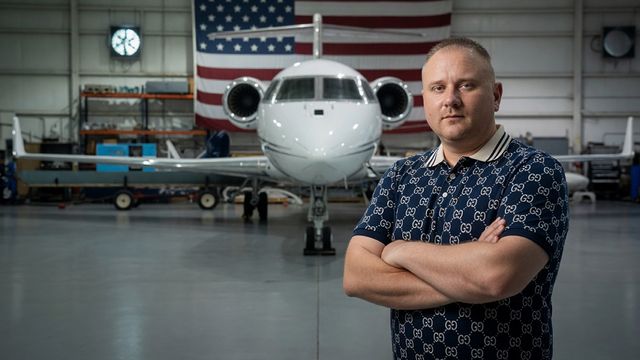
 Watch on YouTube
The full interview, about 38 minutes, filmed beside a private jet.
See all interviews on the Sweat Venture channel
On this page
ExquisiteMAD at a glance
Rhett’s numbers
These are Rhett’s own figures, as he stated them in the interview. They are not Sweat Venture estimates.
| Aircraft detailing | From about $1,000 |
|---|---|
| One mid-size jet, inside and out | About $12,500, over 3 days |
| Basic car packages | Up to the low hundreds |
| Exotic and specialty car work | About $1,400 and up |
| Tanker trailer polishing | About $5,000 to $6,000, in 2 to 3 days |
| A rare car he has detailed | A 1936 Mercedes worth about $11.8 million |
| Gross margin he uses as an example | 30% |
| What a 20% discount leaves on that | 10% |
We have not verified these figures, and your market will differ.
Their path
- Before the businessCold approaches
He waited by exotic cars in parking lots to talk to the owners.
- EarlyCars, then planes
A car customer with a jet asked him to detail it.
- GrowthRoad trips to airports
He visited airports across the Gulf states to pitch aviation detailing.
- NowTraining and licensing
Companies can license his methods, with on-site training.
How they started
Before he had a real business, Rhett would follow exotic cars into parking lots, wait for the owner, and introduce himself. One day, filthy from a full day of work, he walked up to a man sitting on a restaurant patio beside his Lamborghini.
“I’m not interested in detailing your car. I would love to.”
Rhett, at 6:32 in the interview
He asked for five or 10 minutes of advice instead. The owner offered him a drink, and Rhett turned it down. He says that is when the conversation opened up. He got the job, and the owner became a mentor.
A longtime car customer later mentioned his plane. Rhett expected a small single-engine plane and found a jet. He had no idea how to price it.
First equipment
Rhett did not list what he bought first. He named the costs a detailer has to track: chemicals and products, generators, pressure washers, polishers and pads, microfiber towels, and the cost to land each customer.
His company also makes its own soaps that will not corrode aluminum, and sells them to fleet clients, like an oil company in the Bahamas whose tankers it polishes.
The business today
Rhett separates detailing from preservation. On irreplaceable cars, like an all-original early Harley-Davidson, the goal is to remove nothing and risk nothing.
He now offers companies a license to use his methods for a set period, with on-site training for each type of work. He says it is not a franchise.
Pricing
Rhett prices from data, not guesses. With a mentor’s help, he used one mid-size jet as a baseline. He tracked how long each task took and how many ounces of product each surface used. Aircraft pricing now goes by wingspan, and trailer polishing goes by the linear foot.
“If you don’t know your numbers, you’re going to go broke.”
Rhett, at 20:18 in the interview
Travel, mileage, and airfare are extra. He updates prices for inflation every few months.
He is against routine discounts. If you run a 30% gross margin and give 20% off, you keep 10%. A discount also tells customers your work is worth less. He makes exceptions for people who are disabled, elderly, or veterans, and sometimes gives a surprise discount to a loyal customer on a later job.
When he first saw the jet, he worried his price was too high. His mentor asked whether he wanted to be broke or have some money.
Finding customers
Rhett built the aviation side by driving to airports across Florida, Georgia, Alabama, Mississippi, and Louisiana, when he could barely afford the trips. He explained aviation detailing, did a job, then came back to show it off. Airports started sending him their clients.
He says the sales steps are the same in every market, but bigger money means a longer process. The time you spend chasing a $200 job could go to chasing a $5,000 one.
Mistakes and what they would do differently
He says many detailers ask online whether they charge enough. He says the average price of a detail has barely moved in a decade while costs keep rising, so you have to know your own overhead.
Advice for new owners
Comments
No comments yet. Log in to be the first.